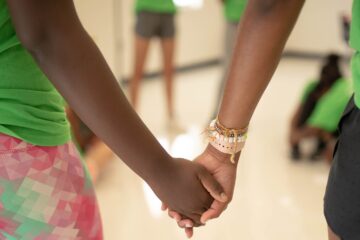

What do girls need from youth programs, and how has that changed since Girls on the Run was founded 30 years ago? We know being a girl today looks different than it did in 1996, but GOTR has grown and adapted to meet the needs of girls throughout its lifetime — and will continue to do so in the future!
The latest installment of Behind the Mission, featuring GOTR CEO Elizabeth Kunz and Chief Program Officer Allison Riley, Ph.D., MSW, explores what today’s girls need, what research tells us about positive youth development, and how those principles inform the Girls on the Run curriculum, coach training, and overall program experience.
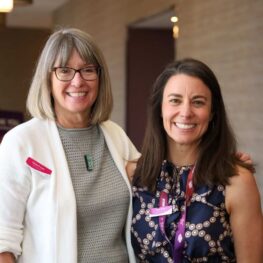
Girls on the Run CEO Elizabeth Kunz (left) and Chief Program Officer Allison Riley, Ph.D., MSW at the 2024 GOTR Summit.
Elizabeth Kunz: Girls on the Run has been serving girls for 30 years. What do girls need from youth programs today, and how has that changed over time?
Allison Riley: Being a girl in 2026 looks different than it did in 1996. The ways girls connect with each other and navigate the world around them have changed. But many of the things girls need as they grow up haven’t changed nearly as much. They still need strong relationships and a sense of belonging, opportunities to build confidence and independence, and space to figure out who they are. We hear girls talk about these same experiences today, but in a context that includes group chats, social media, and being connected nearly all the time. For us, it’s about understanding what girls need as they grow and meeting them where they are today.
EK: What does the research tell us about the kinds of experiences that help young people thrive, and how does Girls on the Run translate that into the program experience for girls?
AR: Research gives us a pretty clear picture of what supports young people’s development. They need opportunities to learn and practice skills and strategies, make meaningful choices, and take on challenges that allow them to experience growth and progress. The relationships and environment around those experiences matter too. Young people need to feel supported and able to be themselves. At Girls on the Run, we put that research into action through our intentional curriculum and coaches who are prepared to bring it to life. Girls learn skills they can use in their lives and have opportunities to practice what they’re learning in a supportive environment. Girls don’t become more confident just because they’re told to be confident. They build confidence as they use those skills, take on challenges, and see themselves make progress.
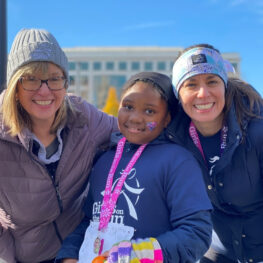
Kunz (left) and Riley pose for a picture with a GOTR girl at a 5K Celebration.
EK: You’ve helped lead the evolution of Girls on the Run programming for more than a decade. How has what we’ve learned over that time shaped the program that girls experience today?
AR: Over 14 years, I’ve seen how much we learn every time we develop a program. Sometimes it’s really specific. I remember testing activities early on or watching coaches lead them and thinking, “Wow, that is not how I thought that was going to go.” Other times, what we learn changes how we think about the program more broadly. Either way, we carry that learning with us. When we developed our newest Girls on the Run curricula, we weren’t starting from scratch. We were able to build on everything we had learned from the programs that came before them.
EK: What are some parts of the Girls on the Run experience that people might not realize are very intentional?
AR: I don’t know that people always realize how much of the experience is designed with a specific purpose in mind. When girls play a game, for example, there’s a learning goal behind it and opportunities to practice what they’re learning throughout the lesson. We’re also very intentional about helping girls connect what they learn at Girls on the Run to their lives outside of it. Even the 5K is about more than physical activity. Girls set a goal, work toward it over the course of the season, and experience what it feels like to accomplish something that may have felt hard.
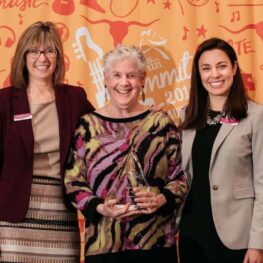
(From left) Kunz, Dr. Maureen Weiss, and Riley
EK: How does Girls on the Run know whether the program is making the difference we intend? What does our research, including the Alums Study, tell us about the skills and experiences that girls carry with them beyond the program?
AR: We have a strong body of research showing that Girls on the Run makes a difference. We’ve studied girls’ experiences and outcomes over time, and now the Alums Study is helping us understand what they carry with them years later. In the study, 85% of alums interviewed identified specific skills and strategies they learned at Girls on the Run and still use years later. More than nine in 10 alums said Girls on the Run helped them resolve conflict, appreciate diversity, help others, and stand up for others. That’s pretty powerful.
EK: Looking ahead, what are you most excited about when you think about the future of Girls on the Run programming?
AR: I’m especially excited about the work we’re doing around middle school. So much changes for girls during those years, including their relationships, growing independence, and the pressures they’re navigating. It’s also a time when many girls become less physically active. We’ve been listening to middle school girls and learning more about what they want and need from programs at this age. That includes strengthening our Heart & Sole program, while also exploring new ways to engage middle school girls. I’m excited about finding more opportunities for Girls on the Run to be part of girls’ lives during these years.